


Our website uses cookies. If you agree with the use of cookies, click the "I agree" button or continue browsing. You can withdraw your consent at any time by changing your internet browser settings and deleting saved cookies. You can read more about cookies. Privacy policy





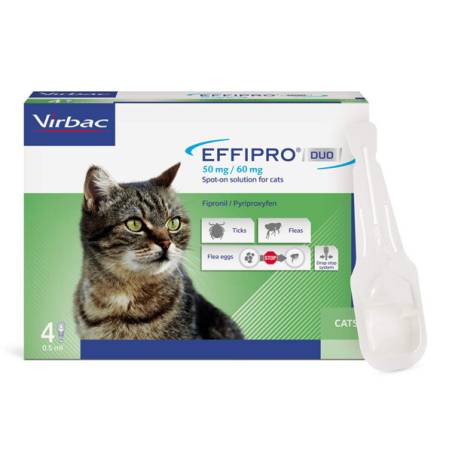
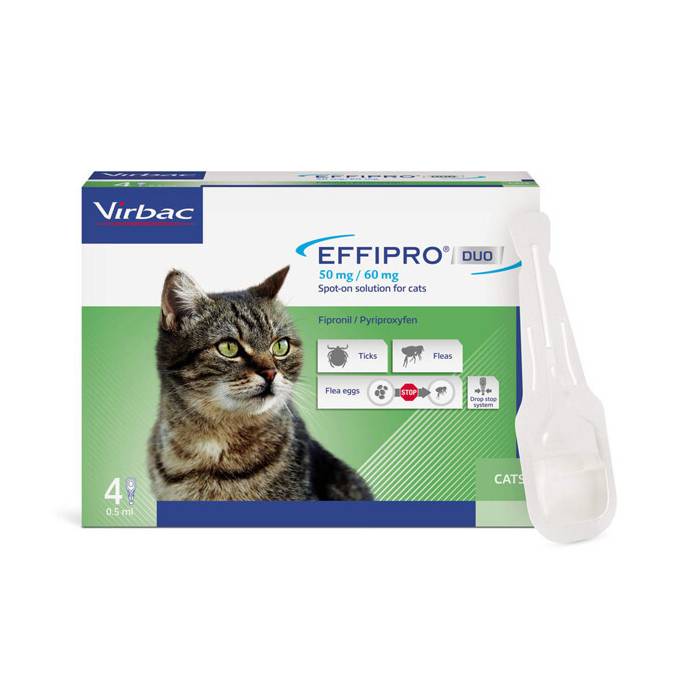
Virbac Effipro Duo 50 mg drop-in solution for cats, N4
1. NAME OF THE VETERINARY MEDICINAL PRODUCT Effipro Duo 50 mg/60 mg drop-in solution for cats
2. QUALITATIVE AND QUANTITATIVE COMPOSITION One 0.5 ml pipette contains: active substances: fipronil 50 mg, pyriproxyfen 60 mg; excipients: butylhydroxyanisole E320 0.1 mg, butylhydroxytoluene E321 0.05 mg. For a complete list of excipients, see 6.1 p.
3. PHARMACEUTICAL FORM Drop-in solution. Clear, colorless or yellowish solution.
4. CLINICAL DATA 4.1. Target animal species Cats. 4.2. Indications for use, specifying the target animal species Intended for use in cats infected with only fleas or fleas and ticks. Use against fleas To treat and protect cats infected with fleas (Ctenocephalides felis). A single treatment with the drug protects against flea infestation for 5 weeks. The drug prevents the reproduction of fleas and stops the development of adult fleas from eggs 12 weeks after its use. The drug can be used as part of a treatment strategy to control flea allergic dermatitis (FAD) when the disease has already been diagnosed by a veterinarian.
Anti-tick use In cats infested with ticks (Ixodes ricinus and Rhipicephalus turanicus). A single application of the veterinary medicinal product provides a continuous acaricidal effect lasting one week. If the cat is infested with ticks while using the medicine, not all ticks may be killed within 48 hours.
4.3. Contraindications Do not use in rabbits, as this may cause adverse reactions or even death of the animal. Do not use in case of hypersensitivity to the active substances or any of the excipients.
4.4. Special instructions for use in individual target animals In two laboratory studies, the coat was moistened 2 hours before the application of the product and twice during the declared period of effectiveness of the product against fleas (every two weeks for the study of the effect on adult fleas and every four weeks for the study of developing fleas). Such wetting of the coat with water did not have a negative effect on the effectiveness of the drug. The effect of shampooing the animals on the effectiveness of the drug has not been studied. If the cat needs to be shampooed, it is recommended to do so before using the veterinary medicine. Once control measures are in place, in the event of an infestation, pet crates, beds and common resting areas such as carpets and upholstered furniture should be treated with a suitable insecticide and vacuumed regularly. In order to reduce the number of fleas in the environment, all animals kept in the house must also be treated with an appropriate flea medicine. The drug does not protect animals from tick ingestion. If the animal was treated with the drug prior to tick infestation, the ticks will be killed within 48 hours of ingestion. This will usually happen before they are engorged with blood, the drug will reduce but not completely eliminate the risk of disease transmission. Often, dead ticks will fall off the animal, and the rest must be carefully removed to avoid leaving the mouthparts of the ticks in the skin.
4.5. Special precautions for use Special instructions for using the drug in animals For external use only. Do not use orally. Animals should be weighed accurately before treatment. The safety of the drug in cats younger than 10 weeks or weighing less than 1 kg has not been established. Care should be taken to prevent the medicine from getting into the animal's eyes. In case of accidental contact with eyes, wash with water. Care should be taken to ensure that the medicine is used correctly, as described in p. 4.9. The medicine should not be applied to wounds or damaged skin. It is important to make sure that the veterinary medicine is applied directly to an area of dry skin that the animal cannot lick and to ensure that the animals do not lick each other after using the medicine. The use of this veterinary medicinal product in sick or debilitated cats has not been studied. In sick or debilitated animals, the medicine can only be used after the responsible veterinarian has assessed the benefit-risk ratio. Additional safety studies have not been conducted, so the treatment can be repeated no earlier than after 4 weeks.
4.10. Overdose (symptoms, first aid measures, antidotes), if necessary In a target animal species safety study in 10-week-old kittens administered up to 5 times the maximum recommended dose of the veterinary medicinal product 3 times every 4 weeks and 6 times the maximum recommended dose every 4 weeks, no serious adverse reactions were observed. However, overdosage may increase the risk of adverse reactions (see section 4.6) and animals should always be treated according to body weight with an appropriately sized pipette.
4.11. Pending Not applicable.
5. PHARMACOLOGICAL PROPERTIES Pharmacotherapeutic group: ectoparasiticides for external use, fipronil, combinations. ATCvet code: QP53AX65. 5.1. Pharmacodynamic properties Fipronil is an insecticidal and acaricidal substance belonging to the phenylpyrazole group. Fipronil and its metabolite fipronil sulfone act on ligand-gated chloride channels, specifically, channels gated by the neurotransmitter gamma-aminobutyric acid (GASR), glutamate (Glu - ligand-gated chloride channels only in invertebrates) gated desensitizing (D) and non-desensitizing (N) channels, thereby blocking the presynaptic and postsynaptic transmission of chloride ions across cell membranes. This causes uncontrolled central nervous system activity and death in insects and mites. Pyriproxyfen is an insect growth regulator (VAR) that belongs to a class of chemical compounds called juvenile hormone analogs. Pyriproxyfen sterilizes adult fleas and inhibits the development of immature stages. The contact molecule prevents the insects from maturing by stopping the development of eggs (ovicidal effect), larval and pupal development (larvicidal effect) and thus killing them. The molecule, touched and/or ingested by mature fleas, also sterilizes maturing eggs before they are laid. The molecule inhibits the infection of immature stage fleas in the environment of treated animals. The combination of fipronil and pyriproxyfen has an insecticidal and acaricidal effect on fleas (Ctenocephalides felis), ticks (Rhipicephalus turanicus, Ixodes ricinus), and also prevents the development of adult fleas from flea eggs. This combination provides integrated flea control and can be used in flea-only or flea-mite infestations.
5.2. Pharmacokinetic properties After application of the veterinary medicinal product to a cat under normal conditions, fipronil and pyriproxyfen are well distributed in the cat's fur during the first day after application. The main metabolite of fipronil is a sulfone derivative, which also has insecticidal and acaricidal properties. Fur concentrations of fipronil and pyriproxyfen decline over time, but both active substances persist for at least 84 days post-treatment (i.e. above the lowest limit of quantification (LOQ) of 100 ng/g fipronil and 50 ng/g pyriproxyfen). Post-treatment concentrations of fipronil sulfone are below the lowest limit of quantification (LOQ 100 ng/ml). The maximum concentration of fipronil and pyriproxyfen in blood plasma is reached quickly - within one day after treatment. Fipronil concentrations were quantifiable in all cats up to 3 days after treatment (LOQ 1 ng/ml). Pyriproxyfen concentrations were quantifiable in all cats up to 42 days post-treatment (LOQ 0.2 ng/ml). Post-treatment concentrations of fipronil sulfone are below the lowest limit of quantification (LOQ 1 ng/ml).
6. PHARMACEUTICAL INFORMATION 6.1. List of excipients Butylhydroxyanisole E320, Butylhydroxytoluene E321, Diethylene glycol monoethyl ether. 6.2. Incompatibilities None known. 6.3. Shelf life The shelf life of the veterinary medicine, if the original packaging is not damaged, is 3 years.
6.4. Special storage instructions Do not store above 30°C. Store in a dry place. Store the pod in a cardboard box to protect the medicine from light.
6.5. Nature and components of the immediate packaging Clear multilayer plastic single-dose pipettes of 0.5 ml, consisting of a heat-formed transparent base (polyacrylonitrile-methacrylate, polypropylene or polyethylene-ethylene vinyl alcohol polyethylene, cyclic olefin copolymer, polypropylene) and a heat-sealed cap (polyacrylonitrile-methacrylate or polyethylene-ethylene vinyl alcohol polyethylene, aluminum, polyethylene-teraphthalate). In the boxes, individual pipettes are placed in external sockets, made of polypropylene, cyclic olefin copolymer, polypropylene and covered with polyethylene-terephthalate, aluminum, polypropylene caps. Boxes containing 1, 4, 24 and 60 pipettes (larger boxes have envelopes to accommodate smaller numbers of pipettes). Not all package sizes may be distributed.
6.6. Special provisions for disposal of unused veterinary medicinal product or waste related to its use Unused veterinary medicinal product or waste related to it must be disposed of in accordance with national requirements. Do not contaminate ponds, waterways or drainage ditches with the veterinary medicine or empty packaging, as this may be dangerous for fish and other aquatic organisms.
7. MARKETING RIGHT HOLDER VIRBAC 1ère avenue – 2065m – L.I.D. 06516 Carros FRANCE
8. MARKETING AUTHORIZATION NUMBER(S) LT/2/16/2330/001-004
9. MARKETING AUTHORIZATION GRANTED/RENEWAL DATE Marketing authorization first granted 03/01/2016
10. TEXT REVISION DATE 04/18/2017
3 other products in the same category:


Customers who bought this product also bought:

- Out of stock
- Out-of-Stock


Recommended Products


Account
-
 For dogs
-
-
-
Leashes and collars
-
-
-
Clothing and accessories
-
-
-
Hygiene and care products
-
-
-
Toys and games
-
-
-
For home and travel
-
-
-
 For cats
-
-
-
Hygiene and care products
-
-
-
Home Equipment
-
Leashes and collars
-
-
-
Pet Transport
-
-
-
Toys and games
-
-
-
 For others
-
-
-
Hygiene and care products
-
-
-
Pet Transport
-
Leashes and collars
-
-
-
Home Equipment
-
Toys and games
-
-
-
 For owner
-
-
Hygiene and care products
-
-
-
 Pet First Aid Kit
-
-
-
-
-
Healthcare products
-
-
-
-
 Beglobiai